Why New Zealand's Roads Demand NZ-Engineered Caravans, Not Imported General-Market Designs
Corrugated metal, river-stone shingle, coastal salt and a 1-in-5 climb out of the campground. New Zealand asks more of a caravan than most markets do. Here's what NZ-specific engineering actually changes.
You can hear it before you can see it. Twenty minutes down a shingle access road, the cupboard latches start chattering, something behind the wall panel has worked loose, and by the time you pull into the campsite a drawer has emptied itself across the floor. The van is three months old. Nothing is broken, exactly. It just was not built for this.
That is the quiet fear sitting behind a lot of caravan purchases in New Zealand: that you have just spent serious money on something designed for flat, dry, sealed, predictable roads somewhere else, and that our country is going to find every weak point in it. It is a fair fear. Plenty of general-market caravans are drawn up for conditions that look nothing like a Coromandel back road in March or the Lindis Pass in a southerly.
What New Zealand actually asks of a caravan
We are a small country with an outsized range of conditions. In a single week of touring you can put a van through:
Sustained gravel and corrugation on the way to the good spots, because in New Zealand the good spots are almost always at the end of an unsealed road.
Steep, tight, camber-heavy climbs and descents. Our hills are short and sharp rather than long and gentle, which loads a chassis and a tow setup very differently.
Salt air on both coasts, often within the same day. Corrosion is not a ten year problem here, it is a two year problem if the detailing is wrong.
Real rain. Not a shower, but sideways West Coast rain that tests every seal, seam and window surround you own.
Big daily temperature swings, so condensation management matters as much as insulation value.
Long stretches off grid, because freedom camping and DOC sites are a huge part of why we do this at all.
A caravan drawn up for a general international market has to be an average of everywhere. Average is fine until you are the one on the shingle.
Where general-market designs come unstuck here
It is rarely one dramatic failure. It is an accumulation of small decisions made for somewhere else.
Vibration, not impact, is the real enemy
Corrugated gravel does not hit a van hard once, it hits it thousands of times a minute. That is what finds under-specified fixings, thin cabinet backing and unsupported plumbing runs. Designing for New Zealand means assuming sustained vibration is normal, not exceptional, and specifying fastenings, bracing and cabinetry mounting accordingly.
Water finds the gaps you did not plan for
Rain driven horizontally at speed behaves nothing like rain falling vertically on a stationary van. Seal design, window surrounds, roof penetrations and the way water is shed away from joins all need to be thought about with our weather in mind.
Weight and balance for our tow vehicles
Kiwi families tow with what they already own, which usually means a mid-size ute or SUV rather than something enormous. Keeping weight sensible and the load balanced is not a spec sheet nicety, it is the difference between a relaxed drive over the Desert Road and a white-knuckle one.
Layouts built around how we actually camp
Long stays on powered sites are one thing. Short hops, wet gear, dogs, bikes and a few nights off grid are another. Storage, entry flow, bed and dinette placement and system capacity all shift when you design around the second pattern.
How Mad RV approaches it
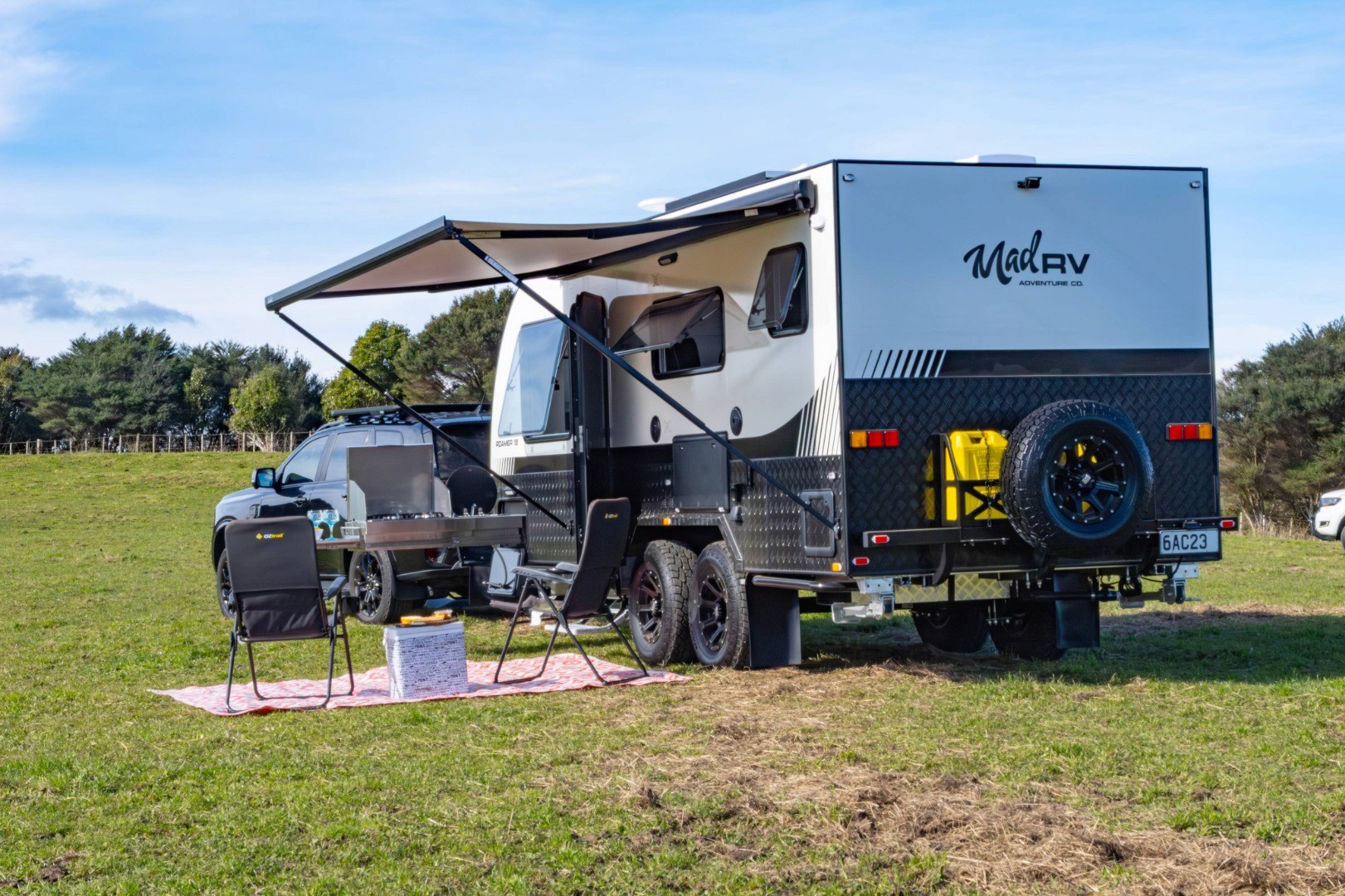
The Roamer range is designed here in New Zealand, by people who have spent more than ten years running Mad Campers rental vehicles up and down both islands. That rental background is not a marketing line, it is a feedback loop. When hundreds of travellers use your vehicles hard, in every season, in every region, you learn very quickly which systems hold up, which layouts work when people are tired and wet, and which clever ideas are only clever in a showroom. That operational know-how goes straight into how the Roamer is specified and laid out.
We design in New Zealand and work directly with our factory, shipping direct to our depots in both islands. That direct relationship is how we keep value high without quietly thinning out the things that matter on our roads. It also means we can change things: layout, internal design and decals can all be customised, because a retired couple touring the Catlins and a family of five doing summer in Northland do not need the same van.
Practical details matter too. Rear door entry keeps the entry flow sensible and the awning side clear. Functional layouts are prioritised over showroom theatre. Panoramic windows are available as an optional upgrade if you want the view, and like everything else in our range they sit on a base model plus add-ons structure, so you choose and pay for what you will actually use rather than inheriting someone else's package.
There is a Roamer for most ways of travelling: the Roamer 16 for easy towing and tight campsites, the new Roamer 17 which is the same proven design with another foot of living space and a choice of Arctic, Onyx or Slate, plus the Roamer 19 and Roamer 21 when you need more room again. Each comes in couple or bunk layout options.
Questions worth asking any caravan brand
Where was this designed, and for which market's roads?
What happens to this van after 300km of corrugated gravel?
What is in the base model, and what is an upgrade? Get it in writing.
Can the layout change to suit how my family travels?
What will my current tow vehicle actually handle, loaded?
There are good caravans in this market from a number of brands, and plenty of happy owners. Our point is narrower than a comparison: ask where the design assumptions came from, because New Zealand is not an average set of conditions and a van designed for the average will show you where it compromised, usually at the far end of a shingle road a long way from help.
Build the van around your roads, not someone else's
If you are weighing up your options for next summer, have a proper look at the Roamer range, compare layouts side by side and work out which base model plus upgrades actually suits the way you travel. Head to madrv.co.nz to browse the full range, check out the new Roamer 17 in Arctic, Onyx or Slate, and get in touch about customising a layout. We are easy to talk to, and we have spent a decade learning what New Zealand does to a vehicle.